Automated migration for legacy systems
New stack.Same behaviour.
stack-shift moves legacy software to a modern stack with AI agents, starting with RPG to Java. A unit is done only when the test setup shows that it behaves like the original.
- RPG → Javafirst language pack, with runtime library
- Golden masterbehaviour recorded on a running IBM i
- Hidden casesdecide acceptance
- Ed25519signed receipt per unit
What makes a stack change hard.
Language models translate code well by now. The work lies in showing that the result does the same thing, and in keeping the way there predictable.
The rules live in the code
Extended over decades, without current documentation. The behaviour is the real specification.
ApproachRecording on the running system: inputs, outputs, files before and after.
Plausible is not equal
An agent writes code that looks right and passes its own tests.
ApproachPart of the recorded cases stays hidden. Only those cases decide acceptance.
Differences at byte level
EBCDIC, packed decimals, fixed record lengths, trailing blanks.
ApproachValues are recorded typed and as raw bytes. The runtime library reproduces the semantics of the original.
The cut-over date
A rewrite has to do on day one everything the old system learned over the years.
ApproachUnit by unit, from the bottom of the call tree upwards. Each one stands on units already checked.
Agents without guard rails
They write wherever they like and guess when something is unclear.
ApproachFixed write permissions per unit. When something is unclear, the agent asks a question with options.
Cost and progress
How far along is the migration, what will the rest cost, where is it stuck?
ApproachThe Leitstand shows progress, usage against fixed limits, a forecast and the bottleneck.
The process in five steps.
From the source tree to the signed receipt. Every step has a result you can check.
- 1
Inventory
The source tree is read: calls, files, copybooks, data areas, cycles.
units.json · levels 0…n
- 2
Recording
On the running system, typed and as raw bytes. Part of the cases is held back.
golden/ · visible + hidden
- 3
Test setup
Build and replay in a container without network, on a fresh copy of the code.
run_checks → green | red
- 4
Series
Agents translate bottom-up. Questions go to people, the other units keep running.
runs · questions · forecast
- 5
Acceptance
Merge request with a signed receipt. Only a person may merge.
receipt.json · Ed25519
The Leitstand.
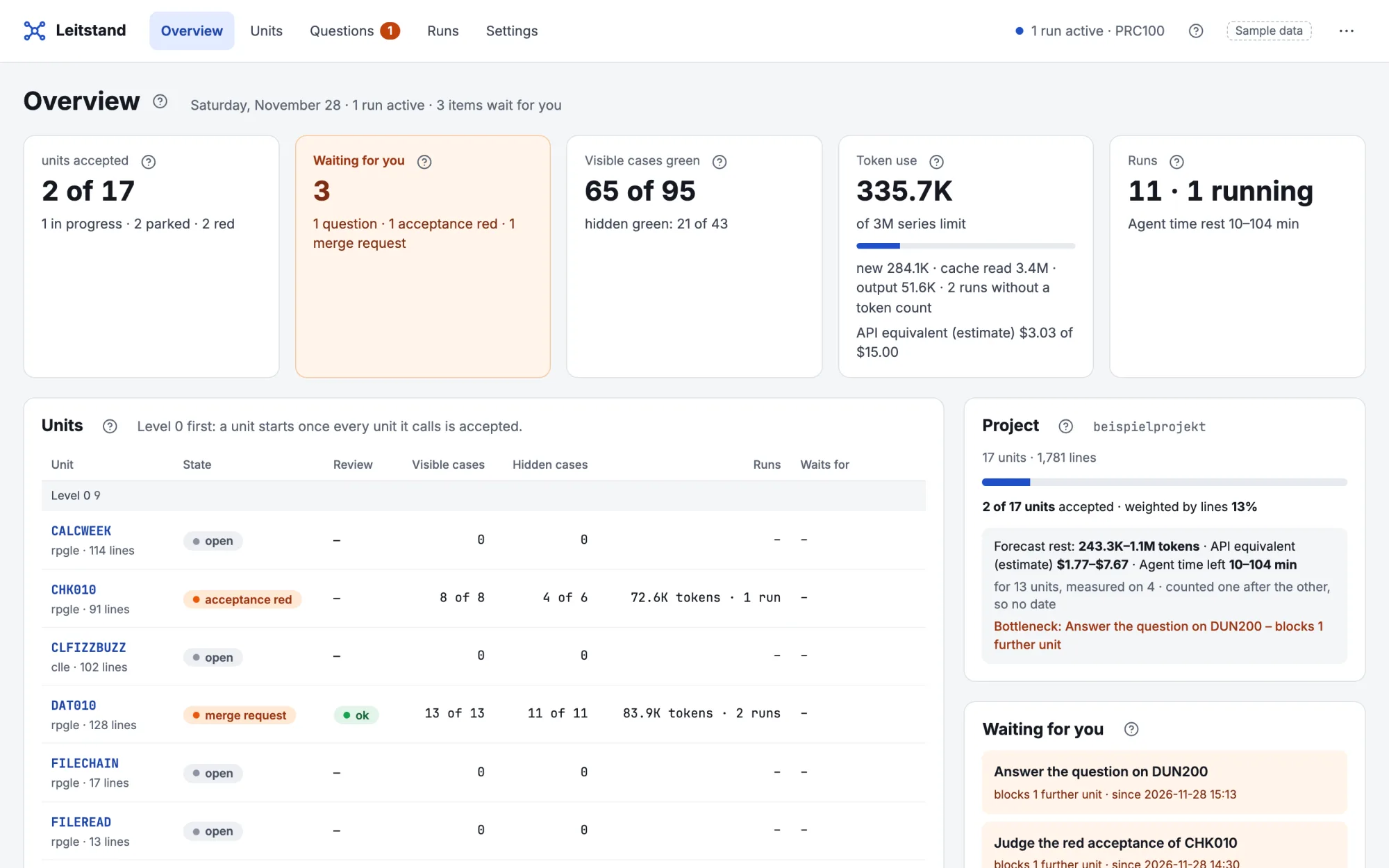
One control room for the whole project: where each unit stands, what is waiting for a decision and what the series has used so far.
Overview: accepted units, hidden cases, token use against the limit, forecast and bottleneck.
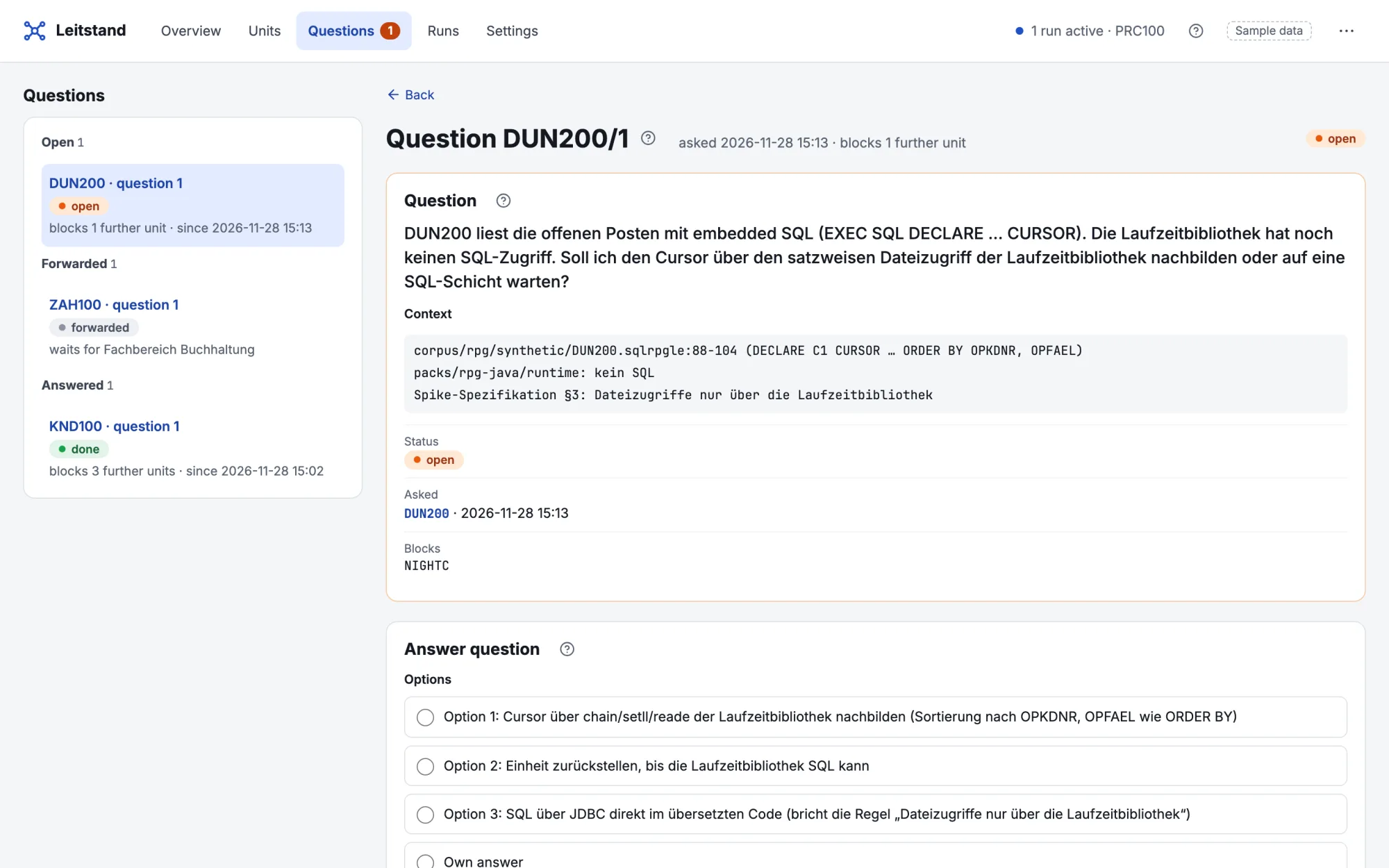
Question: the agent states context and options. The unit waits, the others keep running.
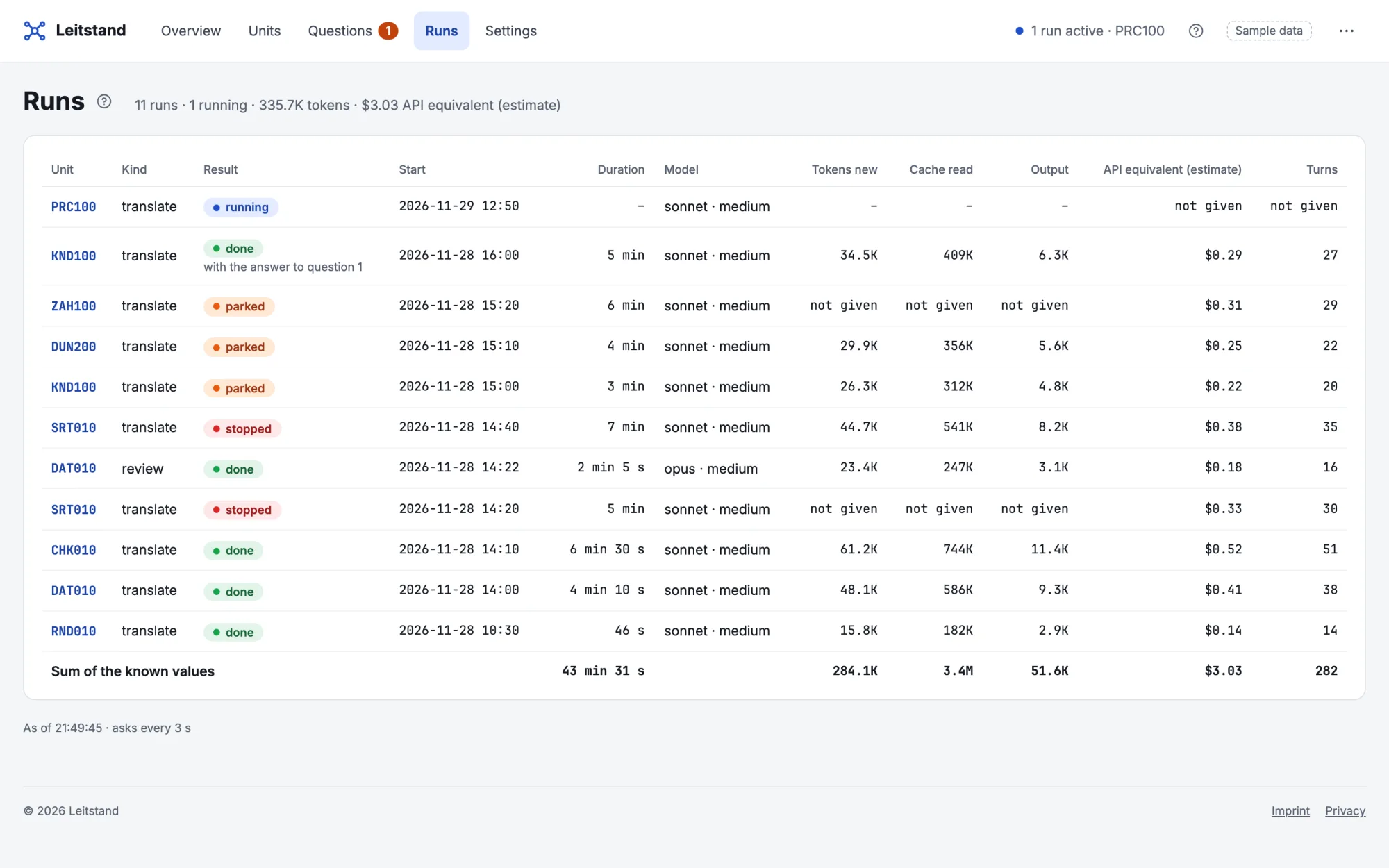
Runs: every agent run with duration, model, tokens and result.
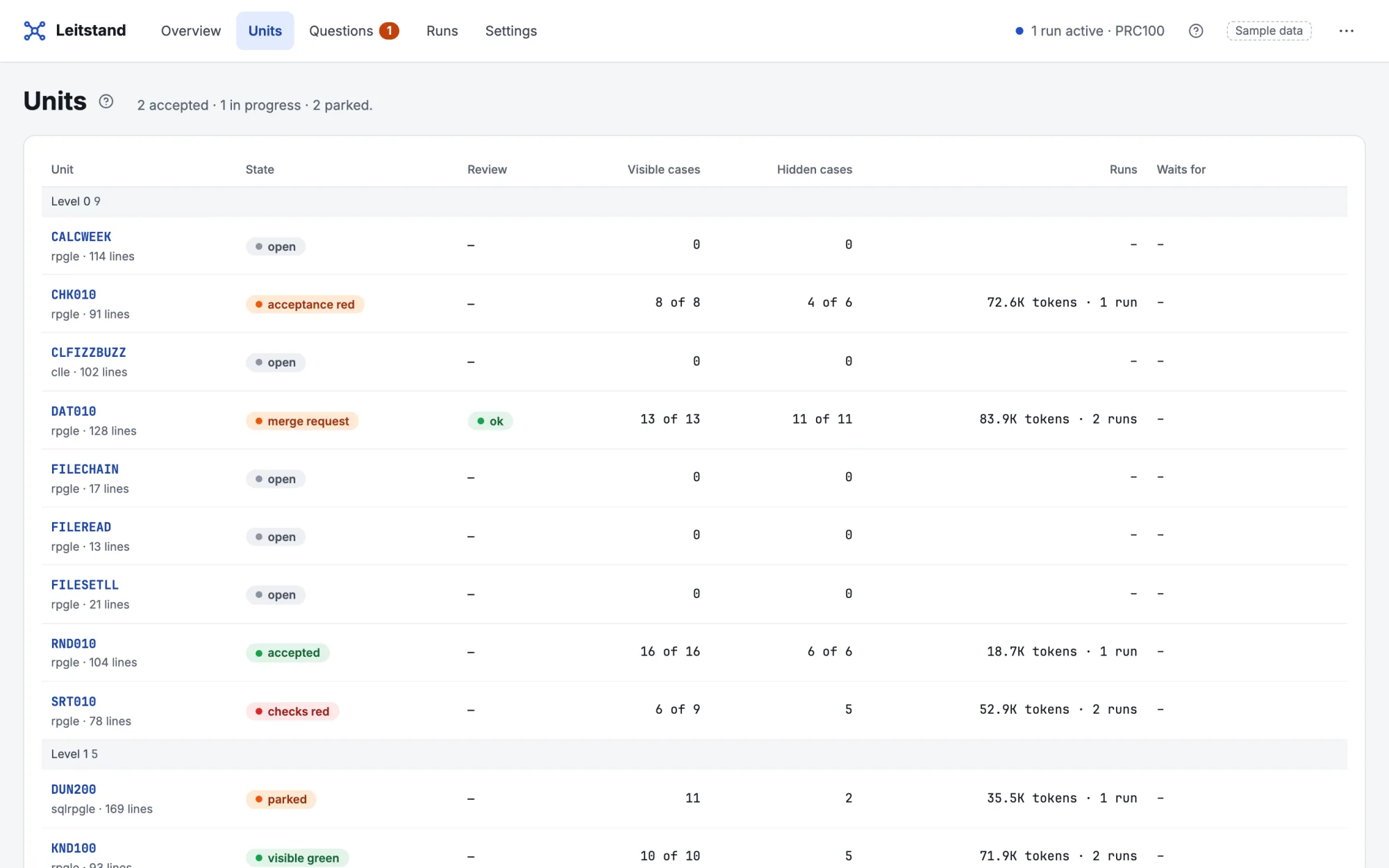
Units: from level 0 upwards, with state, cases and dependencies.
From the prototype
- 23 / 23programs accepted, all on the first attempt
- 108 / 108hidden test cases green
- 0questions needed
- RPG IIIto free-form RPGLE, plus CL and embedded SQL
Test corpus: 23 programs with 3,931 lines in total, mostly synthetic, some third-party code under an open licence. “Equal” means equal on the recorded cases, not formally proven.
Why you can trust the result.
Checks without network
The test setup runs in a container without network, on a fresh copy of the code.
Fixed write permissions
Recordings, source and test setup are locked for agents. Every write is logged.
Questions go to people
Where the recording is not enough, a person decides. The answer flows back into the unit.
You choose where it runs
Orchestration and test setup run on your machine. You decide which language model the agents use and under which contract terms.
Status.
stack-shift is a prototype. What works, what comes next and what is still missing.
Works in the prototype
- Recording on a real IBM i
- RPG → Java language pack with runtime library
- Test setup with hidden cases
- Leitstand, questions, receipts
Next
- Larger real-world code bases
- Pilot projects with partners
Not yet included
- Screen programs
- GitHub or GitLab integration
- Further language packs
How a project starts.
A pilot on a defined slice shows how well the method fits your code base.
- 1
Conversation and inventory
You describe your code base and goal. The inventory shows size, levels and what cannot be resolved.
- 2
Pilot on a slice
A defined part of the code base is recorded and migrated, with the test setup on your system.
- 3
Decision on the series
After the pilot you have the result, the cost per unit and a forecast for the rest.
A legacy system that needs to move?
Tell us briefly which programs you have and what they do. We will get back to you and check together whether a pilot fits.
Email info@sebaro-ventures.de